
Long hours culture, mobility assumptions and toxic academic freedom

In a December 2025 WonkHe article, Richard Freeman from UCL Institute of Education stated “widening participation cannot end at enrolment; it requires sustained support structures that acknowledge the different challenges faced by doctoral students from underrepresented backgrounds”.

This reflects widespread understanding of the need for inclusive practices. But it remains common for gatekeeping of the doctoral “entry ticket” into much of academia to perpetuate poor, exclusionary practices as normal, essential, unavoidable and even laudable. Strategies, policies and processes, from induction to progression to examination to career mentoring are all informed by these, “baking in” barriers.

Resolving the challenges becomes the students’ job, not that of the awarding institute. This has to change.

Research environments need much more work to build inclusive cultures, to enable more diverse doctoral cohorts to thrive, not just survive. This is why much of our research culture work revolves around inclusive cultures, removing barriers and reassessing how we define excellence.

The culture is not built by or exclusively for doctoral students. It is shaped by all academics, particularly professors, for all academics.

A story of five professors

Home life or h-index

A few years ago (this side of 2015) a senior, successful professor stated without apparent irony that women were not properly represented in the professoriate because “when they should be working 60 hours a week to be successful researchers, they are having babies.” Were these ill-advised remarks after a few drinks at a local hostelry, with a bunch of similarly-minded senior academics of limited self-awareness? Not at all. It was during a Faculty research committee. It certainly tested the chair’s skills of calling out and calling in!

Nonetheless, it was instructive by being wrong on so many levels. Why should having babies preclude me from also being a successful researcher? Maybe in part because of the normalisation of long hours he also confidently espoused? Of being available to work in the lab at odd hours, or fly round the world to present results? That he felt comfortable saying this in a committee meeting pointed to the fact his statements were backed up by organisational practices, if not formal policies.

  • Assess quality not quantity in determining research success
  • Retain talent through proper leave and returner programmes, and not just for maternity. Better yet, create a culture that retains and nurtures talent through the career gaps that can arise for anyone.

The diversity tax

Another professor has significant physical disabilities. In addition to using a wheelchair to get around, and having associated health needs, on occasion they experience a “crash”, where they are unable to function effectively. They must focus on rest, recovery and return for some time. They have gained professorial status through the excellence of their academic contribution like everyone else. But it has inevitably taken longer, not only because of the “crash” gaps but also even where of policies, procedures, colleagues have been supportive and appropriate, they have had to advocate for their own needs. They have incurred the “diversity tax” on their time, energy and motivation.

  • Everyone needs to account for differences (disability or otherwise) as they shape policy, expectations, criteria for promotion or funding, and seek to be informed and educate themselves to be effective in this
  • Don’t make the marginalised or underrepresented spend time and energy educating, advocating, challenging in addition to building academic excellence; educate yourself, share the load and build in adjustments by design

Toxic academic freedom

A third professor routinely logged over 2500 hours (i.e. 50 hrs a week on average, with no allowance for annual leave) in “workload modelling” and was actively encouraging research associates on his projects to do the same. This in a sincere belief it was essential to succeeding as an academic.  If you look at the criteria for professorial status in many institutes, as well as how they are often applied in practice, he might not be wrong. Long hours can result in impressive publications lists and impactful outcomes that are rewarded. Looking after your team’s wellbeing is not.

Attempts to address this by trying to reduce his commitments or spread the load were met, ironically, with health concerns. These were never associated with his over-work, but always with a perception that trying to help him manage that (and mitigate the impact on those he mentored) was some form of stress-inducing control. Academic freedom as the choice to damage yourself, build unreasonable expectations in colleagues, and perpetuate a long-hours culture.

  • Don’t let defending the academic freedom to pursue the research you judge to be the most important, fascinating, relevant, leave you and others without support for their wellbeing, health and safety
  • Be aware that if an institute’s policies, processes and norms are informed only by a focus on freedom, they can neglect the legal and moral imperatives to look after people

Representation a necessary but not sufficient condition

A professor told a story about an undergraduate student he encountered. This student had gone to his tutor, saying they were dropping out of their physics degree because they were the only gay person in the department. She (another professor) immediately took him to the next-door office, where the professor was working. He is openly gay, and was able to show this student that gay people were present and successful in physics.

Even though the professor was visible as a gay man in his research community, he wasn’t visible to students in his own department. There wasn’t a culture of sharing, a common theme in science settings where the personalities and experiences of scientists are often set to one side as if they will imperil the purity of discovery through measurement, observation and theory.

  • Leave behind this idea that if the science represents an objective truth, we can ignore that it is a human endeavour, shaped and changed by how people interact. Learn from disciplines where subjectivity is a given, and the best research accounts for that.
  • Don’t leave things to chance, but encourage openness and sharing, acceptance and celebration of difference, and actively demonstrate that everyone can contribute to academic research. Intentionally build an inclusive culture where difficult conversations can take place respectfully and safely.

(Not so) hidden norms and expectations

Another professor shared her experiences as an early- and mid-career academic working towards promotion. She had caring responsibilities for her spouse that meant she could not travel away from without considerable planning and cost. Certainly not for the days and weeks away at conferences which are the core networking and reputation building events in academia. Nether to move around between institutes in her early career, a common practice even now despite redeploying research associates between projects becoming more common. She succeeded without adhering to these two key mobility-based assumptions of academic careers through her own resourcefulness, but also with the support, imagination and mentorship of a handful of colleagues.

  • Watch out for implicit expectations such as the “mobility assumption” or the “long hours fallacy”. They consistently discriminate in against those who are already underrepresented as professors, because they under-pin much of the criteria for promotion.
  • Reward supporting and developing other researchers, and not just by counting doctoral students supervised (which plays into the long hours fallacy). Professorial criteria should value growing an inclusive and diverse population of academics, because that creates sustainability at the institutional level.

Success metrics
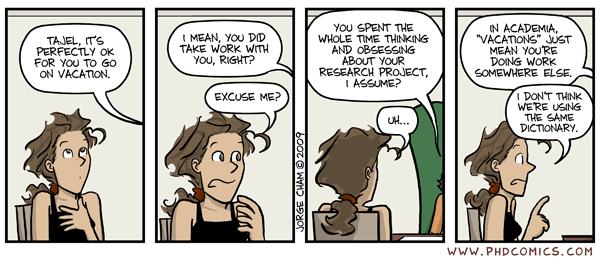
From the archive of "PhD Piled Higher and Deeper" comic. 

Doctoral student Tajel speaking with her supervisor, who is being explicit about what is often implicit, the long hours fallacy writ large.

Text in comic panels:

Supervisor: Tajel, it's perfectly OK for you to go on vacation. I mean, you did take work with you, right?

Tajel: Excuse me?

Supervisor: You spent the whole time thinking and obsessing about your research project I assume?

Tajel: Uh...

Supervisor: In academia "vacations" just mean you're doing work somewhere else.

Tajel: I don't think we're using the same dictionary
From PhD Comics 24th July 2009 illustrating the long hours culture

Five professors of broadly the same age with very different perspectives on how academic success is framed and supported, about who can be a professor. Three men, two women – which is a better balance than exists in the sector. Only the women had to address systemic and cultural barriers. Maybe that is because exceptional stories in the face of barriers is common for successful women and rare for successful men?

Women make up around 50% of those in academic roles and have done for at least a decade. Their representation in the ranks of the professoriate has climbed slowly from 23% to 31% over that same decade. There has been more than enough time for equitable progression to have “naturally” corrected this.

Less than 1% of professors were black in 2023/2024, while black academics filled nearly 4% of other roles*.

If this was a discrepancy in recovery rates from surgery we would be figuring out what we don’t understand, what we are not accounting for, that discriminated against women or black people.

In academic progression, we need to look honestly at the explicit and implicit biases in promotion criteria that favour some groups over others. It isn’t about access to higher education. Women make up half of humanity, and 4% of the UK population is black. They are represented in proportion to their presence in the UK.

Higher education has to address the often gendered, often narrow and often unhealthy assumptions reflected in how we judge eligibility for the title of professor. If we don’t, we are giving doctoral students a false promise of equitable opportunities in academia.

This is why we are working to improve research cultures, be it for doctoral students, early career researchers, professors or the wider academic community. Get in touch to explore how we can support your needs, or learn about our research into how doctoral students understand the interaction between culture and what is valued.


*Academic staff statistics from the Higher Education Statistic Agency OC025 Chart 3 and supporting data. Public data do not allow breakdown by both ethnicity and nationality, so comparison with UK population is indicative only.

This article originally appeared on LinkedIn for Eyres Inclusion Consulting.

Authentic Allyship

Allyship, along with the related concepts of sponsorship and mentoring, has been a powerful contributor to improving the representation of marginalised and minoritised groups.

An ally provides support to those from under-represented groups, for example women in engineering or physical sciences. They can be powerfully helpful to individuals, but to be truly effective they also need to act beyond individual relationships to effect systemic change.

At one point allyship was problematic as an inclusion tool as it often centred the ally, rather than the needs of those benefiting from support. It could be a version of the “white saviour”, with the ally taking instead of enabling agency.

But work to link it to recognising and harnessing privilege in driving change, and connecting it to inclusive leadership has brought a more powerful allyship into being. Jennifer’s Brown Ally Continuum (see the link at the end of this post) is particularly useful and widely adopted. She also refers to it as the Inclusive Leader Continuum, making the key connection that truly inclusive leaders are allies.

The transition from individual ally to strategic allyship is analogous to the shift from not being racist to being actively anti-racist. The mindset change might be as profound.

An Ally’s Journey

On book on my book list for International Women’s Day provides an illustration of this sort of transition. The Book of Queer Prophets is a series of texts where the authors reflect on the interaction between their identities as people of faith and as queer people. They are thoughtful, novel and often moving.

Cover of The Book of Queer Prophets

The final text, presented as an “Afterword” is different.

Reverend Kate Bottley (Kate in the book) shares her journey from responding to a news report about same sex marriage on Gogglebox (her response on camera: “I don’t see what the difference is”) to becoming a genuine ally to queer people through her ministry, as a journalist and within the Church of England where “only Narnia had a bigger closet”. Her narrative is one of changed mindset and honest reflection on never being challenged on how her views might not align with expectations of her as a vicar.

Her progression was gradual, serendipitous and supported by a series of experiences and interactions that helped her move from a passive position of not seeing the difference to actively listening, learning and changing her language. This gradual, organic development is powerful in embedding the shift in mindset. But it can also be incomplete and take some considerable time.

Intentional Allyship

In our work on allyship, we aim to formalise this transition with high quality learning and scaffolding. While this can accelerate the change in mindset, more important is the exploration of motivations, identification of knowledge gaps and addressing blocks on the road to true allyship.

In helping a client develop meaningful allyship programmes, to create effective allies, here are some of what we have found to be important:

  • Uncovering assumptions, biases, gaps in understanding or experiences, and the implications for poorer decision making, environments that exclude or lives diminished.
  • Developing techniques and resilience in identifying areas for growth to be a better ally, such as difficult experiences, hard-to-fill gaps or poor use of language.
  • Recognise where past action or inaction has contributed to exclusion, processing that to allow growth, remembering Emma Dabiri’s exhortation to abandon guilt.
  • The positive role the ally’s privilege plays in ensuring diverse perspectives are accounted for, different people are heard and exclusionary behaviours are called in.
  • Understanding that movement along Jennifer Brown’s Allyship Continuum can be back and forth, as confidence and knowledge develops and challenged in practice.
  • Further that you can be at very different places along the continuum on a variety of inclusion, diversity and experience dimensions, at the same time.
  • Practice being the voice of those who are not included in the “room” be it a physical space or the conceptual ones of teams, committees, peer groups.
  • Becoming comfortable challenging assumptions and pointing out gaps that prevent processes, policies, discussions, and the myriad of ways people work together being truly inclusive.
  • Seeking out different lived experiences, priorities and expectations to develop a rich understanding of the interaction between diversity, inclusion, fairness, success and respect.
  • Amplifying the voices, relevance and presence of those otherwise excluded by absence or dismissal, by ensuring they are listened to, their experiences valued and their ideas recognised.

Simple examples of this last include:

  • Ensuring Global Ethnic Majority people can share their experiences, and the implications are understood and valued by those with different lives.
  • In settings where most people are men, challenging sexism and misogyny as it arises, not just when there is direct impact for a woman who is present.
  • Sharing relevant stories and experiences you have come across and understand, that are counter to the assumptions and expectations informing decision making.

While recognising the tangible benefits for the ally, we ensure they foreground the agency of those they support. Allyship can then have authentic impact beyond the individual, as an ally influences decisions, groups and activities to account for diverse experiences even in the absence of those who lived them.

Allyship development can be stand alone or embedded in wider programmes, and span scales from individuals to whole organisations. Individual development is usually as part of a wider coaching process for inclusive leaders. It is a key tool for developing inclusive cultures where the actions and motivations of individuals is critical.

Eyres Inclusion Consulting was founded by Principal Consultant Dr Stewart Eyres. After nearly 30 years in universities, progressing from doctoral student to Dean of Faculty, he became a consultant specialising in inclusion as a core tool of successful organisations. His practice is informed by a conviction that inclusion has huge and fundamental benefits for every individual. Truly inclusive cultures work for everyone, adapting to changes and openly navigating differences. If this is what you are looking for, or if you need convincing, book a meeting or get in touch, or explore our services.

#InternationalWomensDay #Inclusion #Allyship #Privilege #InclusiveWorkplaces

Originally published on LinkedIn for Eyres Inclusion Consulting.

Inclusion in the Public Sector

Inclusion is not only about meeting the public sector equality duty. The benefits of inclusion for any organisation including better recruitment and retention of a diverse staff base also follow. Diverse teams operating in an inclusive culture are not only more effective at providing services for all, but are more resilient in the face of change or demanding circumstances such as public health emergencies.

Across the UK Social Value aligns deeply with inclusion.

For bodies in Wales, where I am based, inclusive cultures better support meeting the requirements of the Well-Being of Future Generations Act. Positive impacts follow across all seven goals, for example:

  1. A prosperous Wales – McKinsey’s regular Diversity Matters report series consistently show companies with diverse senior teams outperform less diverse competitors.
  2. A vibrant culture and a thriving Welsh language – historically marginalised, the culture of Wales has benefited from the diverse population of the country over centuries, and inclusive cultures can only strengthen a healthy national identity.
  3. A healthier Wales – mental ill-health contributes to social ills, takes people away from work and places additional demands on our health and social care services. An inclusive culture promotes psychological safety, reducing the incidence and impacts of mental ill-health.
  4. A more equal Wales – fundamentally greater equality comes from understanding, valuing and accommodating difference. Inclusive cultures are the most robust and resilient means to embed this within business as usual.
  5. A Wales of cohesive communities – cohesion has many facets, and an inclusive culture naturally lends itself to understanding stakeholder needs, and providing services that account for a diversity of users by design reduces conflict and enhances connections.
  6. A resilient Wales – in the face of challenges, a society that is flexible because of the diversity of its members is better able to weather challenges and recover quickly. An inclusive culture ensures the differences inherent in diversity are harnessed to benefit all rather than separate society’s members.
  7. A globally responsible Wales – one element being Wales’ status as a nation of sanctuary, where inclusive cultures within public services will ensure alignment with commitments to refugees and asylum seekers

What is your experience elsewhere in the UK? Maybe you are part of a public body that has engaged with the PSED or the wider opportunities of inclusive culture in an innovative and impactful fashion.

Diversifying doctoral student programmes

Last week I attended the fantastic 3rd UKCGE Conference on EDI in Postgraduate Research over two days in Leeds. More than 50 doctoral students and leaders of doctoral education gathered to explore how to attract, support and empower a more diverse student body.

Starting with a panel of doctoral students reflecting their varied experiences, including their efforts to support inclusion, and ending with a panel of university staff leading projects to diversify doctoral student admissions, we shared our perspectives and approaches to ensuring we not only recruited a more diverse body of students, but that they were supported to thrive.

I was privileged to lead two round tables on the Tuesday morning based on our pilot study of how doctoral students understand research culture. Participants immediately saw the relevance, and recognised the value of exploring this alongside the hugely important work to establish an inclusive, positive research environment. Further discussions over the two days established a consensus that we can’t simply assume the work to shape the environment through culture change will naturally percolate across to change the influence research culture has on how research is carried out. This validated our assumptions and has encouraged us to progress with the work .

We are exploring other implications from our pilot study data, ahead of publishing a more complete analysis. In the mean time, we are interested in extending the collaboration to different academic disciplines, including doctoral students, supervisors and leaders of doctoral programmes. As our study develops, we will also be seeking a steering group.

Critical to our approach is the core inclusion paradigm of “nothing for us without us”. We are experienced doctoral supervisors, as well as leading research groups and doctoral programmes – and of course were doctoral students at the start of our research careers. But we know we need to include the perspectives of current doctoral students in shaping our work, and disciplines beyond our own experiences in science.

Please get in touch so we can keep you informed and seek opportunities to involve you.

Culture shaping research

Recently I’ve become interested in how all the work on improving research culture interacts with the how, who, what and where of the research itself. In the UK, funders are increasingly concerned with how research is carried out, that is the culture. The UK Government’s R&D People & Culture strategy defines the target culture as:

There is a positive, inclusive and respectful culture that attracts a diversity of people to work and thrive in R&D in the UK and encourages them to stay.

When I speak with university research leaders, many are grappling with what this means, be it in order to meet REF and UKRI expectations, align with university missions or improve the experience and success of researchers including doctoral students. Very often they are unsure how to support early career researchers and doctoral students to understand what these expectations mean.

There is a huge body of work focussed on creating a positive research culture, for example with the aim of improving the well-being and progression of doctoral students. It is incredibly important work, and done properly will improve the experience of all researchers, as it will not be effective if carried out in isolation.

But what if we end up assimilating a more diverse body of researchers into a research paradigm that remains rooted in the privileged perspectives of white, privileged, European men?

I believe that in order to assure a future where an increasingly diverse body of researchers can thrive, we need to consciously address the interaction between research culture and research. In my discipline of Astronomy, the explicit culture is that data is the arbiter of truth. But in practice many fundamental research questions, such as the origin of life, the formation of stars and planets, or the fate of the universe are being contested via individual personalities, priorities and interests. The implicit culture is one of individual leaders drawing together groups of supporters.

Without making any judgement on how the research “should” be conducted, nonetheless making the implicit explicit is essential to a healthy culture. Otherwise it is difficult to evaluate and make adjustments to improve that culture. It allows the convention that science is separate from the identities, personalities and life experiences of scientists to perpetuate, rather than it being a human endeavour with all the complexities that embodies.

In other academic disciplines, critical examination of the concepts, assumptions, modes and methods of carrying out research is a core element of training for doctoral students. I can’t comment on what I haven’t experience. But this diversity of approach, coupled with a public perception that research finds fixed definitive “answers” that is not even true for scientific results, led me into wanting to complement the essential work on positive research cultures with work to make explicit the interaction between research cultures (explicit or implicit) and how research is conducted. It may be that this is as important to the overall success of researchers as a positive culture that supports their wellbeing and success while they are students.

As a first step, I’ve worked with Dr Cristina Izura to pilot a survey with UK doctoral students that suggests they have both an understanding of and an interest in how research culture shapes the value given to their research. I’m looking forwards to sharing the results at the 3rd UKCGE Equality, Diversity & Inclusion Conference in Leeds on the 4th November 2025. I’ll report back my experiences here shortly afterwards.